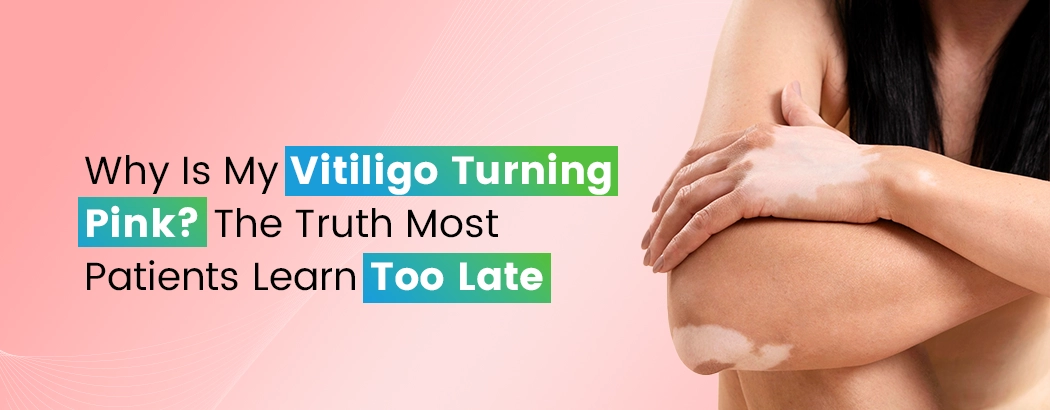
Why Is My Vitiligo Turning Pink? The Truth Most Patients Learn Too Late
You had finally started accepting the white patches. Life felt stable again.
Then one day, you notice something different. The patch is not white anymore. It looks pink.
Your mind fills with questions. Is it spreading? Is it healing? Is something wrong?
This is the moment many patients feel anxious and confused. If your vitiligo is turning pink, here is what you need to know before you ignore it.
Why Does Vitiligo Turn Pink?
Vitiligo happens when melanocytes, the cells responsible for producing pigment, stop functioning or are destroyed by the immune system. This leads to depigmented white patches.
But pink discoloration can appear for several reasons. It is not random.
Common Reasons for Pink Color in Vitiligo
|
Possible Cause |
What It Means |
Should You Worry |
|
Increased blood flow |
Skin is reacting or healing |
Usually not serious, but needs monitoring |
|
Inflammation |
Active immune response in the area |
Yes, may indicate progression |
|
Reaction to treatment |
Skin responding to medication or light therapy |
Often positive but requires doctor supervision |
|
Sun sensitivity |
Depigmented skin is more prone to redness |
Needs protection and care |
|
Irritation from creams |
The skin barrier may be compromised |
Review treatment with the doctor |
The challenge is this. Two people can see pink patches for completely different reasons. Without a medical evaluation, you cannot be certain what stage your vitiligo is in.
Is Pink a Sign of Healing?
In some cases, yes.
When patients undergo proper treatment, mild pinkness can indicate:
-
Increased circulation in the affected area
-
Early stages of repigmentation
-
Skin responding positively to therapy
This is why some dermatologists consider slight redness a transitional phase before pigment starts returning.
However, pink color can also mean the disease is still active. If the immune system continues to attack pigment cells, the area may appear inflamed before turning fully depigmented again.
This is where many patients get confused.
They wait. They hope. They assume.
And that delay can cost time.
The Emotional Impact of Sudden Color Change
Vitiligo is not just a cosmetic concern. It deeply affects emotional well-being.
When patches change color again, it triggers:
-
Fear of worsening condition
-
Anxiety about spreading
-
Social insecurity
-
Loss of confidence
-
Mental stress
Many patients say they feel like they are starting from zero again.
The emotional pain becomes heavier when there is uncertainty. Not knowing whether it is healing or worsening creates constant stress.
The Mistake Most Patients Make
When vitiligo turns pink, common reactions include:
-
Ignoring it for weeks
-
Searching random information online
-
Trying home remedies
-
Stopping prescribed treatment
-
Switching creams without consultation
Vitiligo does not always behave slowly. In some individuals, it can progress rapidly during active phases.
A pink patch may be a temporary stage. Or it may be a sign that immune activity is ongoing.
Only a proper medical evaluation can clarify this.
Waiting too long reduces the opportunity to adjust treatment early.
When Should You Consult a Doctor?
You should not delay medical advice if:
-
Pink areas are increasing in size
-
New white patches are appearing
-
There is itching, burning, or sensitivity
-
Current treatment does not show improvement
-
You feel emotionally distressed due to changes
Early monitoring allows doctors to adjust therapy, protect remaining pigment cells, and manage progression effectively.
Vitiligo management is often more successful when addressed in its active stage rather than after widespread depigmentation.
Why Early Action Matters
Vitiligo is an autoimmune condition. That means the immune system plays a major role.
During active stages, immune activity may be stronger. If pink discoloration reflects inflammation, timely intervention can help:
-
Stabilize the condition
-
Prevent rapid spread
-
Improve chances of repigmentation
-
Reduce long-term skin damage
Patients who act early often have better control over their condition compared to those who wait for visible worsening.
Can Stress Make It Worse?
Yes.
Emotional stress can influence autoimmune activity. When patients feel anxious about sudden color changes, stress hormones can indirectly affect the immune response.
This creates a cycle:
Color change leads to stress.
Stress may worsen immune activity.
Immune activity may affect the skin further.
Breaking this cycle requires clarity and medical guidance, not silence or delay.
The Truth Most Patients Learn Too Late
The biggest mistake is not the pink patch itself.
It is assumed that it will settle on its own without understanding the cause.
Sometimes pink is a sign of healing.
Sometimes it is a sign of active disease.
But without evaluation, you are guessing.
And when it comes to vitiligo, guessing can delay proper treatment adjustments.
Your skin is sending signals. Ignoring them does not make them disappear.
Final Thoughts
If your vitiligo turns pink, stay calm but take it seriously.
Track the changes and consult a specialist early. Proper monitoring can help you control the condition and prevent progression.
Timely action often makes all the difference.