
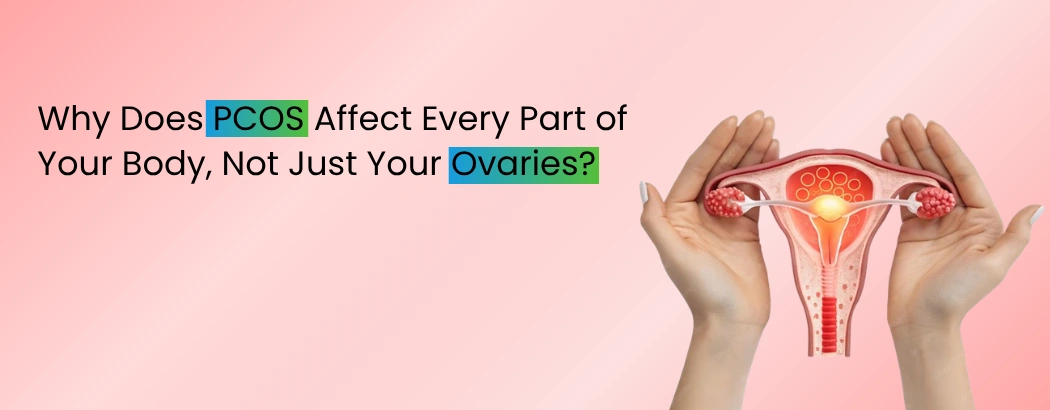
Why Does PCOS Affect Every Part of Your Body, Not Just Your Ovaries?
Polycystic Ovary Syndrome (PCOS) is, perhaps, the most misnamed condition in modern medicine. When we label a systemic metabolic disorder after a single anatomical feature—the ovaries—we inadvertently shrink our understanding of the condition. We frame it as a reproductive obstacle, a fertility issue, or a cycle-related quirk. In doing so, we ignore the reality of the millions of women who live with PCOS every day: a condition that touches the skin, the metabolism, the mind, and the very foundation of their long-term health.
PCOS is not an ovarian disease. It is a systemic endocrine and metabolic phenomenon. It is a complex, multi-layered disorder that influences how your cells respond to energy, how your hormones communicate, and how your body manages inflammation. When you have PCOS, your body is operating on a different, more volatile metabolic baseline. Understanding why it affects everything from your hair density to your mid-afternoon energy levels is the first step toward reclaiming your health.
The Metabolic Engine: The Core of the PCOS Struggle
To understand the systemic nature of PCOS, you must first look at the "engine" of your metabolism: insulin.
For many people with PCOS, the body exhibits insulin resistance. Think of insulin as a master key. Its job is to unlock your cells so that glucose—the sugar from your food—can enter and be converted into usable energy. In PCOS, that key becomes difficult to use. Your pancreas, sensing that the cells aren't getting enough fuel, compensates by producing massive amounts of extra insulin.
This hyperinsulinemia (high levels of insulin in the blood) is the primary driver of the PCOS cascade. It travels throughout your body, causing far more than just period irregularities:
-
The Liver and Lipid Profile: High insulin forces the liver to produce more lipids, often leading to skewed cholesterol levels that are difficult to manage through diet alone.
-
The Adipose Tissue: Insulin is a "storage" hormone. When levels are chronically high, your body is biologically signaled to store fat, particularly in the visceral area around your midsection, rather than burning it for fuel.
-
The Adrenal Glands: Chronic insulin spikes add stress to your adrenal system, which can exacerbate feelings of anxiety and persistent, low-level fatigue.
The Androgen Effect: Systemic Aesthetic Consequences
The overproduction of insulin has a direct "downstream" effect on your hormone balance. It stimulates the ovaries and the adrenal glands to churn out excess androgens (male-type hormones like testosterone). While androgens are essential for all women, their excess is what causes the wide-reaching aesthetic symptoms of PCOS.
The Dermal Impact
Your skin is, in many ways, the report card of your endocrine health. High androgen levels significantly increase sebum (oil) production, which feeds the bacteria responsible for deep, cystic acne. This is not "teenage acne" caused by poor hygiene; it is a hormonal eruption that is largely unresponsive to topical soaps and washes.
The Hair Cycle Interference
Hair follicles are highly sensitive to androgenic signals. Excess testosterone can lead to a process called miniaturization on the scalp, where the follicles become progressively smaller and produce finer, thinner hair. Simultaneously, the same hormones encourage terminal, coarse hair growth on the face and body. This contrast—losing hair where you want it and growing it where you don't—is a defining, and often emotionally taxing, hallmark of the systemic nature of PCOS.
Clinical Design Tip: True health is found in the proactive analysis of your body's subtle shifts, not in waiting for the crisis point. Explore how we decode these early indicators before they disrupt your life: Why Do So Many Health Conditions Go Undiagnosed Until They Start Affecting Your Daily Life?
The Silent Driver: Chronic Inflammation
Beyond insulin and androgens, PCOS is characterised by a state of low-grade, chronic systemic inflammation. This is the "hidden" symptom that explains why so many women with PCOS feel a generalised sense of physical unwellness, joint discomfort, or skin sensitivity.
Inflammation in PCOS isn't just a byproduct; it is a fuel source. It further drives insulin resistance, which increases androgen production, which in turn fuels more inflammation. It is a vicious, self-sustaining feedback loop. This inflammation is why people with PCOS often find that they "feel" the stress of their environment more acutely than others, and why they may take longer to recover from physical exertion or injury.
The Danger of Lifestyle-Only Management
Given the systemic nature of PCOS, it is deeply concerning that many patients are still given the generic advice: "Just eat less and exercise more." While lifestyle choices are an essential part of the equation, they are not a cure-all for an endocrine system that is fundamentally misaligned.
If your "metabolic engine" is misaligned, simply pushing the gas pedal (harder workouts) or removing the fuel (extreme calorie restriction) can often lead to further burnout. For the PCOS patient, management must be clinical, diagnostic, and layered.
-
Metabolic Stabilisation: Using targeted interventions to restore insulin sensitivity at the cellular level.
-
Hormonal Calibration: Addressing the androgen excess to stop the cascade of acne, thinning hair, and unwanted hair growth.
-
Inflammatory Control: Implementing systemic protocols to break the feedback loop of inflammation.
Why You Should Seek Proactive Clinical Support
Because PCOS touches every organ system, waiting for the diagnosis to become disruptive is a strategic mistake. By the time your symptoms are severe enough to warrant an aggressive intervention, the metabolic pathways have been altered for years.
Proactive clinical management looks at your biomarkers before you reach the threshold of daily disruption. It tracks your trends. It recognises that a change in your skin quality or your energy levels is a vital piece of data, not just a cosmetic annoyance.
At Minnerva Clinic, we treat PCOS as the systemic disorder it is. We recognize that when you walk through our doors, you are not just looking for a way to regulate a cycle; you are looking to regain control over your body’s entire physiological baseline. You want your energy back, you want your skin to reflect your health, and you want a body that finally works with you, not against you.
Reclaiming Your Agency
Living with PCOS doesn't mean living with symptoms that you are forced to rationalise away. It means understanding that your body has a specific physiological blueprint that requires specific, data-driven support. You have the agency to step away from generic advice and toward a tailored, restorative strategy.
Do not wait for your body to demand your attention through a crisis. Start the process of internal alignment today.
🔴 REQUEST A SPECIALIZED PCOS CONSULTATION
Are you tired of managing your PCOS symptoms in isolation? It is time for a clinical approach that looks at your full metabolic picture. Connect with our team for a comprehensive, confidential assessment.
-
Direct Hotline / WhatsApp: +91 7080213331
-
Our Premium Clinic Location: Minnerva Clinic, Lucknow, Uttar Pradesh
-
Book Your Appointment: Visit our Digital Booking Portal