
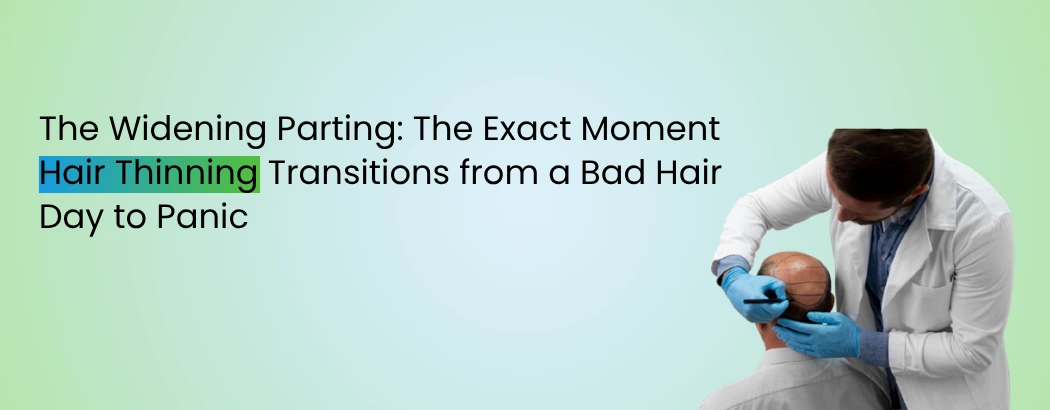
The Widening Parting: The Exact Moment Hair Thinning Transitions from a Bad Hair Day to Panic
There is a specific, quiet moment when you realize that your morning routine has fundamentally changed. You are standing in front of the bathroom mirror, perhaps under the harsh fluorescent lighting, and you try to style your hair as you have for years. You part it in your usual spot, but something is wrong. The white line of your scalp looks just a little bit too wide. You push your hair to one side, then the other, hoping to catch a better angle, but the result remains the same: the density is shifting.
In that heartbeat, the frustration of a "bad hair day" vanishes, replaced by a cold, sharp spike of panic. You begin to trace the history of your hairline in your mind, wondering when the thinning actually started. Was it the stress last month? The change in shampoo? Or is this something permanent?
This "widening parting" is the most common early warning sign of androgenetic alopecia and general hair thinning. It is a slow-motion transition that, for many, remains the greatest source of daily grooming anxiety. To move past the panic, we must understand the life cycle of a hair follicle and why standard, store-bought solutions are often failing to address the root biological cause.
The Biology of Density: Why Your Parting Changes
Hair is not just a strand of keratin; it is a complex biological organ rooted in the scalp, governed by genetics, hormones, and systemic cellular health. When you notice a widening parting, your scalp is signaling that the hair growth cycle is failing to reset itself properly.
The Miniaturization Process
Every hair on your head goes through three phases: the growth phase (anagen), the transitional phase (catagen), and the resting phase (telogen). In a healthy scalp, when a hair falls out, a new, thick strand grows in its place.
Hair thinning begins with miniaturization. Due to the influence of hormones like DHT (dihydrotestosterone), the hair follicle slowly shrinks. Instead of producing thick, terminal hair, the follicle starts producing thin, wispy, "vellus" hair. These hairs are so fine that they fail to provide the coverage they once did. The parting widens not necessarily because you have fewer follicles, but because each individual follicle is producing significantly less substance.
The Role of Scalp Health and Micro-Circulation
If your scalp is chronically inflamed, or if the micro-circulation—the flow of blood and nutrients to the follicle—is sluggish, the miniaturization process accelerates. Your hair follicles are like a garden; if the soil is dry and nutrient-poor, the growth will be stunted regardless of how much you "fertilize" the surface with topical oils or shampoos.
Clinical Design Tip: Addressing structural and aesthetic insecurities requires moving beyond the "masking" phase and into the restoration phase. Explore how clinical precision can rectify the false narratives of your physical appearance: You Look Exhausted — When Your Under-Eyes Keep Lying About How Much Sleep You Got
The Fix-It Fallacy: Why Your Routine Fails
The industry is saturated with products promising "thicker, fuller hair." But here is the reality: most of these products are essentially heavy waxes or volumizing polymers that coat the hair shaft to make it appear thicker. They provide a temporary aesthetic illusion, but they do absolutely nothing to stop the miniaturization happening at the follicle level.
By relying on these products, you are simply delaying the inevitable. You are trying to use a band-aid on a structural issue. When the underlying biology is ignored, the panic will only intensify as the widening of the part becomes harder to disguise.
The Path to Restoration: Clinical Precision
True hair restoration is about intervening in the miniaturization cycle and creating a scalp environment where follicles are nourished, stimulated, and protected.
1. Regenerative Scalp Therapy
Advanced clinics now utilize regenerative medicine—such as platelet-rich therapies—to deliver high concentrations of growth factors directly to the hair follicles. These growth factors act as biological signals, telling the miniaturized follicles to "wake up" and restart the production of thick, terminal hair.
2. Laser and Photobiomodulation
Using specific wavelengths of light, we can stimulate the mitochondria within the hair follicle cells. This increases cellular energy, improves local blood flow, and extends the active growth phase of the hair. It is a non-invasive, systematic way to treat the scalp from the inside out.
3. Precision Follicular Support
In more advanced stages, clinical interventions focus on blocking the conversion of testosterone into DHT, preventing further miniaturization. When combined with localized nutritional support, this creates a sustained growth environment that reverses the thinning trend.
Reclaiming Your Confidence
The panic you feel when looking at a widening part is valid, but it is also a starting point. It is the moment you stop accepting the bad hair day narrative and start demanding a clinical answer. You do not have to live in a state of constant grooming anxiety, constantly checking mirrors and adjusting your hair to hide your scalp.
When you address the root cause with clinical precision, you reclaim the freedom to style your hair however you choose—not as a way to hide, but as a way to express yourself.
🔴 REQUEST A SPECIALIZED HAIR DENSITY EVALUATION
Ready to stop the cycle of panic and discover the exact clinical path to density restoration? Connect with our elite team for a confidential, personalized assessment of your scalp and follicle health.
-
Direct Hotline / WhatsApp: +91 7080213331
-
Our Premium Clinic Location: Minnerva Clinic, Lucknow, Uttar Pradesh
-
Book Your Appointment: Visit our Digital Booking Portal